

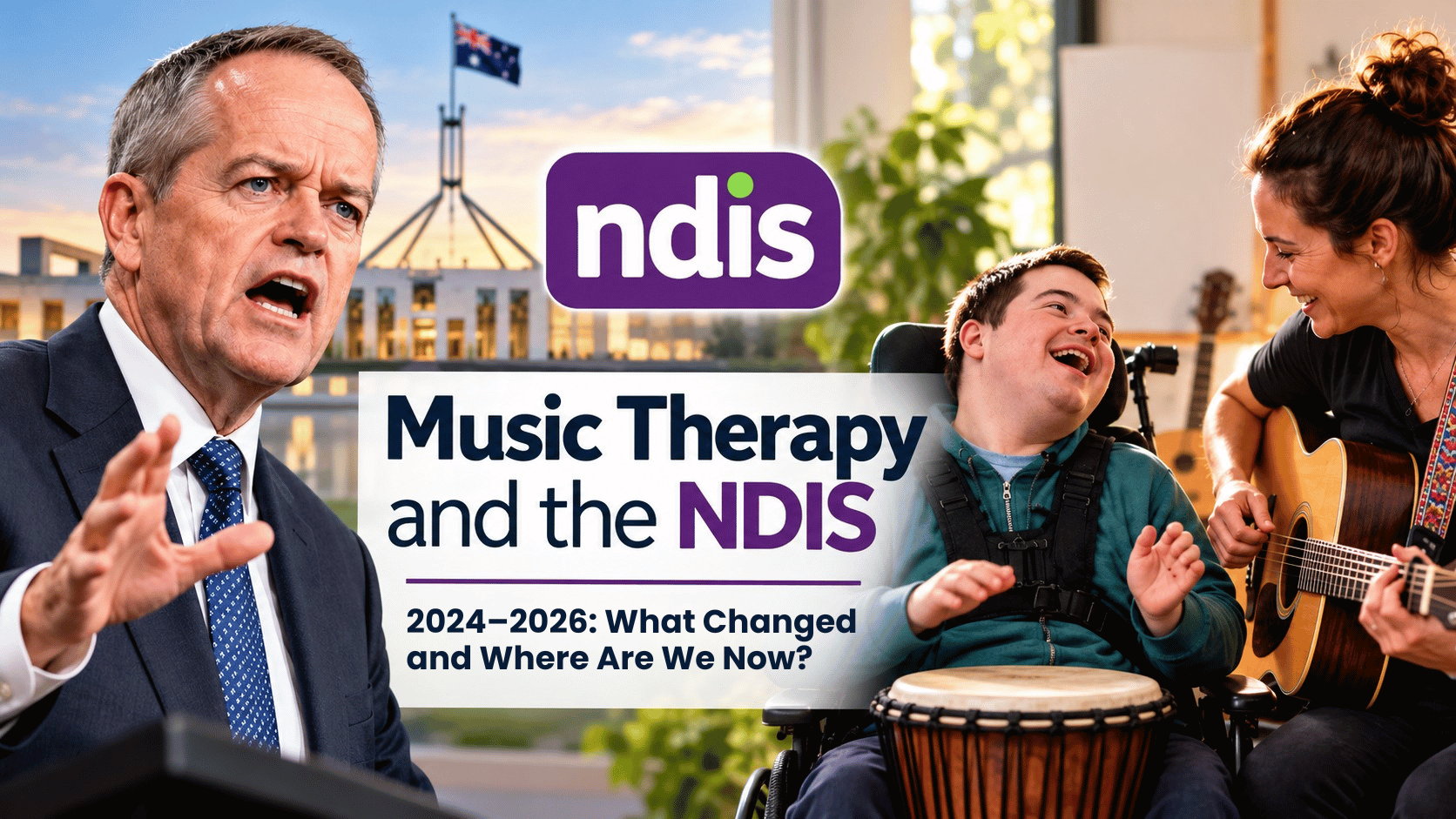
For many families, music therapy is much more than simply playing instruments or enjoying favourite songs.
Registered Music Therapists use music purposefully to work towards therapeutic goals such as communication, emotional and sensory regulation, social interaction, movement, cognition, engagement and participation.
One of the questions we are regularly asked at Pitch Waves Music Therapy is:
Can music therapy be funded?
The answer is yes, depending on the person, their goals and the funding scheme involved.
In Australia, music therapy may be accessed through funding pathways including the National Disability Insurance Scheme (NDIS), some insurance and compensation schemes such as iCare, and parts of the aged care system. Private and self-funded services are also available.
However, the position of music therapy within the NDIS has gone through an important period of uncertainty and review over the past two years.
What happened to music therapy under the NDIS in 2024?
In October 2024, new NDIS legislation and definitions of NDIS supports came into effect.
At that time, music therapy continued to be recognised as an NDIS-funded therapeutic support when delivered by an appropriately qualified Registered Music Therapist.
However, in November 2024, the Australian Music Therapy Association (AMTA) became aware of a proposed major change to the way music therapy would be classified and funded under the Scheme.
The NDIA subsequently announced that, from February 2025, music and art therapy would no longer generally be treated in the same way as other therapeutic supports.
Under the proposed arrangement, many participants who had previously accessed individual music therapy at the existing therapy rate would instead have been expected to access music-based support through a community participation rate of approximately lowered by 3 times, unless music therapy was specifically stated and justified within their plan.
For music therapists, participants and families, this was a significant concern.
It was not simply a change to an hourly rate. There were concerns that substantially reducing the available funding could make individual clinical music therapy difficult to provide and, in turn, make it harder for participants to continue accessing a therapy they had been using to work towards their disability-related goals.
AMTA publicly challenged the proposed change and argued that music therapy is an evidence-based allied health profession delivered by university-qualified Registered Music Therapists.
Families, participants, therapists and other members of the disability community also spoke publicly about what music therapy meant to them and the outcomes they had experienced.
Why was the decision reviewed?
The NDIA's original position was that the available evidence did not sufficiently demonstrate that music and art therapy met the evidentiary requirements to be universally classified as therapy supports under the new NDIS framework.
This became a contested issue.
AMTA argued that the profession had an established research base and that the proposed change had been made without adequate consultation with the music therapy profession about that particular decision.
The Government and NDIA maintained that stronger evidence and clearer distinctions were needed between clinical music therapy and recreational or community-based music activities.
Rather than proceeding immediately with the proposed February 2025 changes, the NDIA commissioned an independent review of art and music therapy, led by health economist Dr Stephen Duckett AM.
Importantly, the planned changes were deferred while that review took place.
The review ultimately received input from more than 600 people, including people with disability, families, therapists, providers and professional bodies.
What did the independent review find?
The independent review concluded that art and music therapy can be effective and beneficial for people with disability in appropriate circumstances.
It recommended that music therapy continue to be funded as a therapeutic support where:
there is evidence that the therapy is likely to benefit people with similar disability-related needs and goals
the intervention is connected to the participant's functional needs and NDIS goals
the service is delivered by a suitably qualified therapist registered with the recognised professional association.
The review also recommended a clearer distinction between music therapy and ordinary music activities.
That distinction is important.
A music lesson, recreational music group or general music activity is not automatically music therapy.
Music therapy involves assessment, clinical reasoning, therapeutic goals, planned intervention, documentation and review by a qualified music therapist.
So, is music therapy still funded by the NDIS?
Yes.
Music therapy continues to be recognised as an NDIS-funded therapy support where it meets the NDIS funding criteria and is appropriate for the participant's disability-related needs and goals.
The NDIA's current guidance specifically lists music therapy among the therapy supports that may be funded.
From November 2025, the national NDIS price limit for music therapy was adjusted following the independent review.
The NDIS also provides specific music therapy support items for:
direct therapy
non-face-to-face clinical work
provider travel
telehealth
cancellations where applicable
NDIA-requested reports.
This is an important outcome because music therapy remains formally recognised within the Scheme as a distinct professional therapy service.
The role of the Australian Music Therapy Association
The Australian Music Therapy Association played a significant role throughout this period.
AMTA publicly raised concerns when the proposed funding changes became known in November 2024, wrote directly to the then NDIS Minister - Bill Shorten, provided evidence and submissions, met with government representatives, and encouraged the music therapy and disability communities to participate in the review process.
AMTA's advocacy focused particularly on preserving access to music therapy for NDIS participants and demonstrating that Registered Music Therapists are qualified allied health professionals working towards measurable therapeutic and functional outcomes.
The final independent review did not simply return the system to exactly where it had been before. The pricing framework changed, and the NDIS has placed a stronger emphasis on evidence, functional outcomes and distinguishing therapy from recreational music participation.
However, the final outcome confirmed something extremely important:
Music therapy continues to have a place within the NDIS.
Why does this matter?
For some people with disability, conventional verbal or highly structured therapies can be difficult to access.
Music can create another pathway for interaction.
A therapist might use rhythm to support movement and motor planning, singing to encourage communication, musical turn-taking to practise social interaction, or carefully structured music experiences to support regulation, attention and engagement.
For another person, songwriting or improvisation may provide a way to practise decision-making, emotional expression or self-advocacy.
The music itself is not the end goal.
Music is the therapeutic tool used to work towards the person's individual goals.
This is also why the distinction between a Registered Music Therapist and a music teacher, entertainer or recreational music facilitator matters.
Who can provide NDIS-funded music therapy?
Under current NDIS guidance, therapy supports must be delivered by appropriately qualified professionals.
For music therapy in Australia, this means working with a Registered Music Therapist (RMT) who is registered with the Australian Music Therapy Association.
Registered Music Therapists undertake recognised tertiary education in music therapy and are required to maintain professional standards, continuing professional development and professional registration requirements.
At Pitch Waves, our music therapy services are provided by Registered Music Therapists.
Can iCare fund music therapy?
Music therapy may also be considered through NSW insurance and compensation arrangements, including schemes administered by iCare, depending on the person's circumstances and the approval of the relevant insurer or case manager.
Music therapists generally fall within the broader category of allied health practitioners who are not individually SIRA-approved professions.
For non-SIRA-approved allied health practitioners, treatment generally requires prior approval from the insurer, and the practitioner must demonstrate why the proposed service is clinically appropriate and connected to the person's injury, rehabilitation or functional goals.
Fees are also normally agreed with the insurer before services commence.
This means iCare funding is not automatic, but music therapy may be considered on an individual basis where the insurer approves the therapy.
For these clients, we can provide initial assessments, clinical goals, reports and treatment recommendations where required by the funding body.
What about aged care funding?
Music therapy is also recognised within Australia's aged care system.
My Aged Care lists music therapy within allied health and therapy services.
Depending on the person's aged care program, assessed needs and service provider, music therapy may therefore form part of an individual's allied health support.
Music therapy in aged care can be used to support areas such as communication, cognition, emotional wellbeing, social connection, movement, engagement and quality of life.
Other ways to access music therapy
Not everyone who accesses music therapy does so through the NDIS.
Depending on the person's circumstances, services may also be:
approved through compensation or insurance arrangements
accessed through aged care services
commissioned by schools, disability organisations, hospitals or community services
funded through organisational or grant-based programs
Eligibility and approval requirements differ considerably between schemes, so it is always worth checking the person's specific funding arrangements before beginning therapy.
Where things stand today
The period from late 2024 to 2025 created genuine uncertainty for thousands of participants, families and Registered Music Therapists.
What followed was also an important example of why evidence, lived experience, professional advocacy and consultation matter when decisions are being made about disability supports.
The independent review did identify areas where the music therapy evidence base and NDIS framework could be strengthened.
At the same time, it confirmed that music therapy can provide meaningful therapeutic benefit and should continue to be funded by the NDIS when there is evidence that it is appropriate for the individual participant.
Today, music therapy remains an NDIS-funded therapeutic support.
For families, that means the focus can return to the question that matters most:
Is music therapy appropriate for this person, and can it help them work towards the goals that matter in their everyday life?
At Pitch Waves Music Therapy, we work with children, adolescents and adults across a range of disability and support needs. If you are unsure whether music therapy may be suitable for you, your family member or someone you support, you are always welcome to contact us to discuss their goals and current funding arrangements.
Funding eligibility depends on the individual's circumstances, plan, funding body and current funding rules. Information in this article is general and should not be treated as a guarantee that a particular service will be funded.